CL&W Subdivision - Overview
The CL&W [Cleveland, Lorain & Wheeling] Subdivision is based on a branch of the B&O [now CSX] that runs from Sterling, OH to Cleveland, OH. Much of the traffic of this low density freight-only line serves a large steel mill in the Cuyahoga Flats area, Ford Motor Company assembly plant in Valley City, and a handful of smaller lineside industries.
The visible* modeled right-of-way (indicated by the solid blue lines on the schematic) represents the northern end which originates at Clark Avenue Yard, just inside the Cleveland city limits. It then passes thru the industrial suburb of South Brooklyn, followed by a brief run thru a semi-rural area, then the town of Brook Park. A local way freight continues thru staging from Brook Park to a small industrial center in Valley City, OH, where it gets pointed back toward the north after swapping-out cars at the interchange. In addition, two daily locals run between Clark Avenue Yard and the Ford assembly plant on the outskirts of Valley City.
[* visible = photo-worthy areas with scenery/structures ]
With exception of a pass-thru intermodal and an occasional ore train from Republic Steel downriver, all southbound trains originate in Cleveland either at Clark Avenue Yard or Erie Steel. Most are destined for New Castle, PA, to be redirected on toward the Atlantic Seaboard or the coal mines of West Virginia; however, a few merchandisers get sent west to Willard, OH.
The two division-point terminals, represented by staging, likewise funnel northbound traffic onto the CL&W to terminate at Clark Avenue. A small percentage of this traffic gets sent further north over the Pennsy [later Conrail] connection, to two large off-layout industries: a General Motors assembly plant and a coal-fired Ohio Edison electric generating facility.
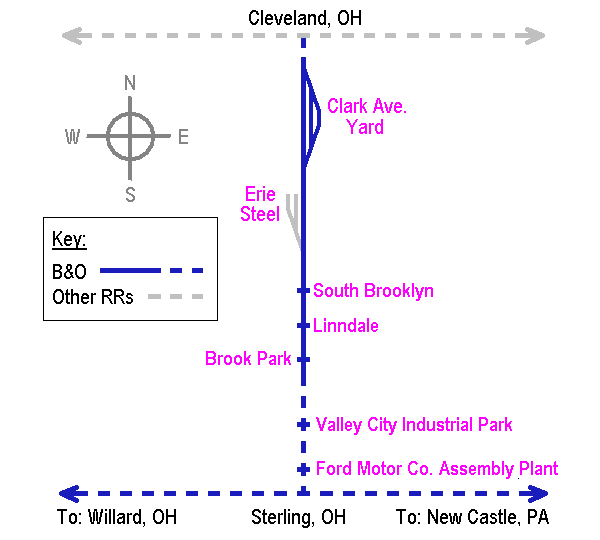
Figure 1: CL&W Subdivision schematic route map
Modeler’s License – Deviations from Prototype
To fit within the limited 24x24ft available space while providing maximum operating enjoyment, a few liberties had to be taken in representing the Cleveland leg of the CL&W subdivision:
1)
The real CL&W has rarely [if ever] carried bridge traffic after 1980; it is now a branch line that serves only its local trackside industries, up to and including Cleveland’s sole remaining integrated steel mill: LTV Steel Corp [now Arcelor-Mittal], fictionally named “Erie Steel” on the layout.
2)
While the layout portrays the Ford assembly plant as being somewhere north of Clark Avenue yard, the prototype actually exists directly off the Lorain half of the CL&W “wishbone” at Lester, OH. [Its rail cars never go anywhere near Clark Avenue yard].
3)
The turn-around local [Valley City Turn] is modeled as originating from Clark Avenue and running south to the Valley City interchange, where it is turned and sent back to Clark Avenue. The real local turned around a bit further south at an interchange yard in Lester, OH.
4)
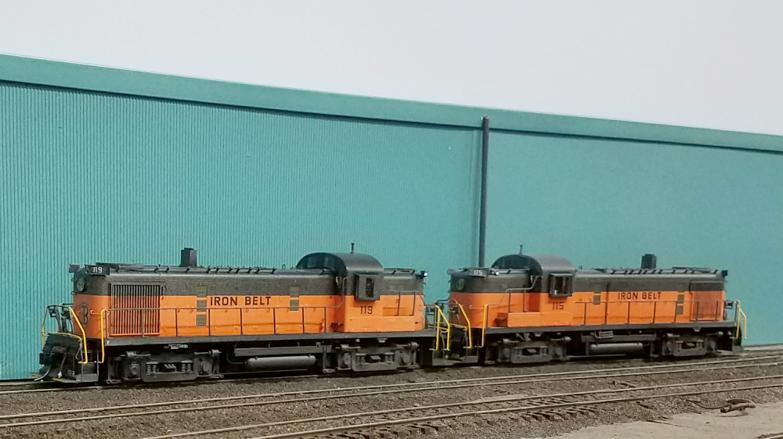
The prototype LTV Steel complex sits directly adjacent to Clark Avenue yard; its intra-plant railroad operations are handled by the Cleveland Works Railway Operation (CRWO), affectionately nicknamed “the CROW”. LTV’s model counterpart Erie Steel is served by a fictional short line, the Iron Belt, with trackage rights over the B&O; its orange-and-black locomotives haul rail traffic between Clark Avenue and its own corporate yard.
5)
The model Erie Steel produces its own coke for its blast furnace and receives unit train loads of bituminous coal. LTV Steel, in contrast, receives fully-processed coke in unit trains of special Coke Express extended-height hopper cars. [Not really a problem, since they're beyond the modeled era.]
6)
The Ford Motor Company had a huge engine manufacturing facility located in Brook Park, OH, along with an assembly plant. Due to limitations in space and quantity of rolling stock, the 1:87 Ford plant is fictionally located in Valley City and only performs final assembly of vehicles.
7)
As most B&O experts know, passenger trains never ran on the prototype CL&W right-of-way after the 1930's. However, to keep things interesting for guest operators, a short “stub” passenger train will occasionally appear on the 1:87-scale CL&W to connect with the Cincinnatian on the Toledo Sub.
______
____